Useful preschool maths activities help children connect numbers with real quantities, compare objects, notice patterns and explore shapes. You can try these ideas at home in Cyprus with familiar toys and household routines. Begin with an amount your child can handle, talk about what happens and change one part of the game when they are ready.
The six activities below are suggestions for family play, not a timetable or assessment used by Golden Oak. They complement our broader guide to preschool activities and learning through play by focusing specifically on early number and mathematical language.
1. Set a place for each toy
Put three soft toys around a pretend picnic. Offer a small collection of toy plates and ask your child to give each toy one plate. Count the toys together, then the plates. Ask: “Does everyone have one?”
The useful idea is matching one object to one other object. If a toy has two plates and another has none, invite your child to adjust the arrangement. You do not need to introduce a worksheet to make the problem visible.
Make one change: bring another toy to the picnic. Ask what needs to change on the table. If the original amount is too much, start with two toys and keep the conversation short.
2. Build a tower to match a number
Choose a small number, say four, and build a tower of four large blocks. Touch each block once as you count. Then ask: “How many blocks are in the tower altogether?” Your child can count again if they want to check.
Next, put the same four blocks in a line. Ask whether there are still four. The activity gives you a way to talk about quantity even when the arrangement looks different.
Make one change: build a second tower with one extra block. Place the towers side by side and compare them. Use matching blocks if you want height to reflect the number of pieces; mixed sizes can produce a different result and a different discussion.
3. Copy and continue a pattern
Arrange large coloured blocks in a repeating sequence: blue, yellow, blue, yellow. Say the pattern aloud together, then leave a space for the next block. Ask your child to choose what belongs there and explain the choice in their own way.
You can make the same kind of repeating pattern with actions, such as clap, tap, clap, tap. This keeps the idea available when you are away from the toy box.
Make one change: let your child create the pattern and ask you to continue it. Deliberately pause to explain your thinking: “I saw blue and yellow repeating, so I looked for blue next.”
4. Become shape detectives
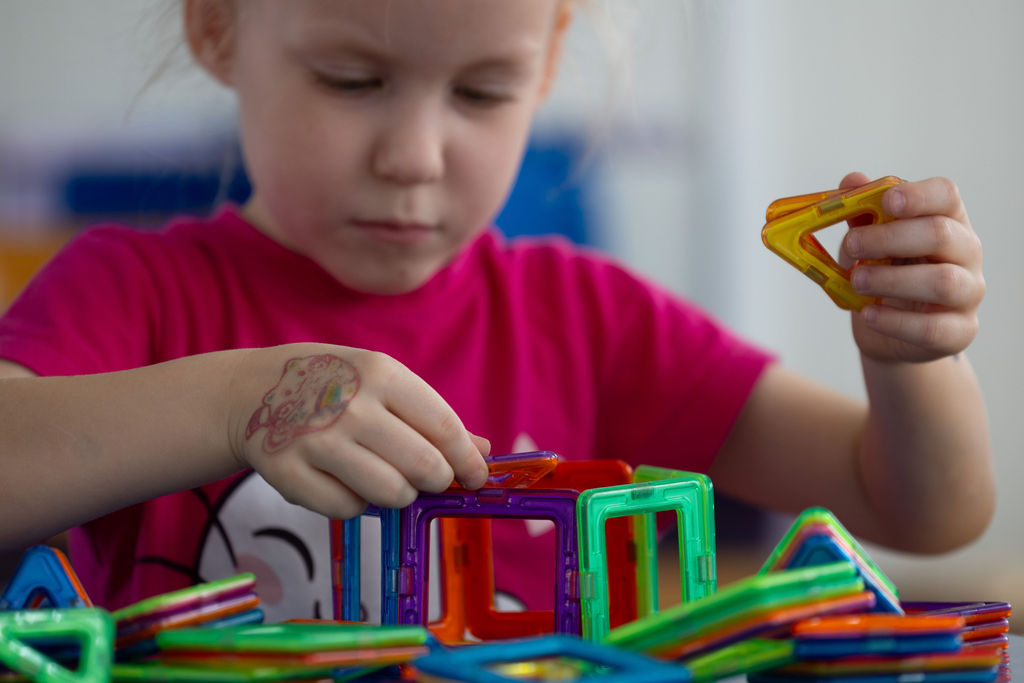
Gather a few large construction shapes or draw simple shapes on paper. Find examples with straight sides and examples with a curved edge. Turn a triangle around and talk about what stays the same.
The magnetic construction pieces in this article’s photograph offer one example of a resource that can prompt conversations about triangles and squares. The activity does not depend on buying the same set.
Make one change: ask your child to build or draw a picture using two kinds of shape. Invite them to describe a part of the picture: “Which shape did you choose for the roof?” Accept pointing and showing as part of the conversation.
5. Compare two collections
Place three toy cars in one row and five in another. Ask which row has more cars and how you could check. Pairing the cars across the rows can make the difference visible; counting each group offers another way to investigate.
Keep “more”, “fewer” and “the same number” connected to the objects. A long, widely spaced row can look larger even when it contains fewer cars, so move the cars and check again together.
Make one change: ask your child to make the collections equal. There is more than one possible move: adding cars to one group or taking some away from the other. Talk about the choice rather than insisting on one route.
6. Measure a familiar object with blocks
Place equal-sized blocks end to end along the edge of a picture book. Ask how many blocks long the book is. Help your child notice gaps or overlaps, then compare it with another book using the same blocks.
This is a practical introduction to measurement language: longer, shorter and the same length. It also gives counting a purpose that your child can see.
Make one change: try larger blocks and compare the count. Talk about why fewer large blocks might cover the same edge. You can leave the explanation at the level your child finds interesting.
Choose a game for the idea you want to explore
| Activity | Conversation starter |
|---|---|
| Toy picnic | Does each toy have one? |
| Block towers | How many are there altogether? |
| Repeating patterns | What comes next, and what repeats? |
| Shape detectives | What can you notice about the sides? |
| Two collections | Which has more? How can we check? |
| Block measurement | Which book is longer using these blocks? |
Keep preschool maths playful and manageable
Choose age-appropriate resources and stay involved in the play. If the game becomes frustrating, reduce the number of objects, demonstrate one turn or return to a familiar version. You can also stop and come back another day. This guide is an activity bank, not a set of milestones to complete in order.
When talking with the teacher, share what you noticed: for example, “She counted the blocks accurately but started again when I moved them.” That observation opens a more useful discussion than a label such as “good at numbers”. Ask which classroom idea would be helpful to revisit at home.
Explore early learning at Golden Oak
Golden Oak’s Kindergarten and Preschool in Cyprus is the place to explore the school’s Early Years provision. On a school tour in Limassol, ask how adults use play, materials and conversation to develop early mathematical ideas.
For the later stage, Cambridge Primary Mathematics includes number, geometry and measure, and statistics and probability, with an emphasis on explaining mathematical thinking. That Primary framework is useful context for the years ahead; it is not a preschool entry checklist.