Fine motor skills help preschool children control the small movements involved in drawing, turning pages, handling objects and using everyday tools. Before early writing becomes neat letters, there is a great deal to explore through play: moving a puzzle piece into place, pressing a shape into dough or making a purposeful mark on paper.
For families choosing a preschool in Limassol, these moments offer a useful window into learning. This guide focuses on hand control and early mark-making, with practical invitations to try at home. The activities are suggestions for family play; your child’s teacher can help you choose a suitable starting point.
What are fine motor skills, and how do they connect with writing?
Fine motor skills involve controlled small movements. The Department for Education’s early years guidance on fine motor development connects hand skills with everyday independence and explains that physical development works across the whole body. Manipulating an object and stabilising the body are connected parts of a task.
For parents, that means a pencil is one tool among many. Watch how your child holds something, adjusts it and uses the other hand to help. Those observations can be more informative than asking whether a finished picture looks tidy.
Five playful invitations for preschool hand skills
Use age-appropriate materials and supervise the activity. Start with familiar objects your child can handle comfortably. You can offer one invitation at a time rather than creating a programme to complete.
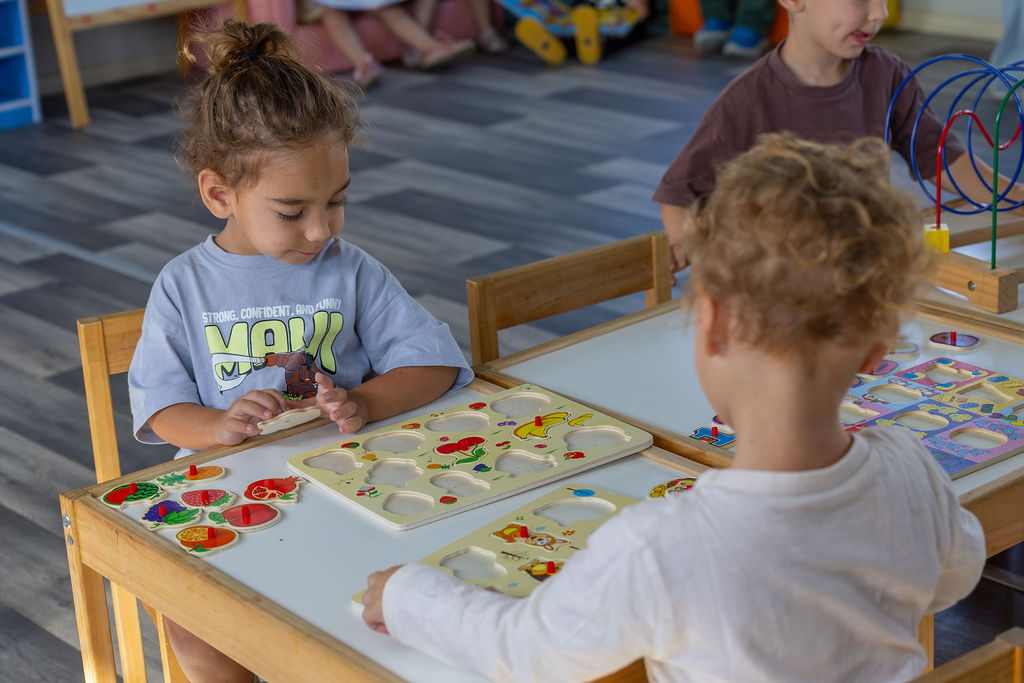
1. Make a small-world puzzle station
Choose a familiar wooden puzzle. Invite your child to move a piece to the board, turn it and decide where it belongs. If a piece will not fit, pause before solving it. You might say, “What could you change about the way it is facing?”
Keep the conversation about the action: turning, lining up and trying again. If there are too many pieces to manage, offer a smaller selection. Let your child decide which piece to explore next.
2. Build a pretend bakery with dough
Offer suitable play dough and a clear surface. Your child could make pretend bread for toy customers, flatten a small pizza or press a pattern into a dough biscuit. Let the story give the hands a job.
Try joining the play as a customer: “Could you make one long loaf and one round loaf?” Follow your child’s ideas without expecting a particular finished shape. Put the materials away when the activity loses its appeal.
3. Create a paper landscape
Invite your child to tear strips of paper for a sea, a garden or an imaginary road. They can arrange the pieces before gluing them onto a larger sheet. Talk about which part they want to hold still while the other hand works.
You could add a drawn route across the collage, then move a toy along it. The picture becomes a setting for play, with plenty of reasons to adjust, position and make marks.
4. Draw a route for a favourite character
Put a toy at one side of a large sheet and draw a destination at the other. Invite your child to make a route between them with a suitable crayon or brush. The route might loop around a lake or stop at a pretend shop.
Ask your child to tell you where the character is going. Follow the route together and let them add signs or symbols if they wish. A line can carry a story before it resembles conventional writing.
5. Give an everyday task a clear purpose
Choose one manageable job, such as turning the pages while you share a book or opening a familiar container at snack time. Make time for your child to try, and offer help with the part that is difficult.
Describe a useful action you noticed: “You held the box with one hand while you lifted the lid.” A specific observation gives the child something recognisable to try again.
Make room for marks that mean something
The Department for Education’s guidance on early writing highlights meaningful mark-making, physical control and expressing ideas. It is guidance for England, rather than a statement of Cyprus school requirements.
At home, invite your child to explain a drawing, create a pretend menu or add a label to a model. You can write down the words they dictate and read them back. This connects their spoken idea with a visible message while leaving their own marks intact.
Early writing and phonics answer different questions: one concerns expressing and recording ideas; the other helps connect sounds with letters. Our phonics and early-reading guide explores that separate part of literacy.
Notice the process and share useful observations
Instead of comparing pictures with another child’s, describe what happened during the activity. Did your child turn the paper to reach a space? Did they try a different way of joining two pieces? Which part did they enjoy repeating?
If a task regularly frustrates your child, tell the teacher what you noticed and ask which materials or level of challenge would be useful. A concrete example, such as difficulty keeping paper still, gives the conversation a clear focus.
Early learning at Golden Oak in Limassol
Golden Oak’s Kindergarten and Preschool programme in Agios Athanasios includes making, hands-on exploration and creative mark-making. Kindergarten and Pre-Reception follow a developmental Early Years programme; Cambridge learning begins in Reception.
On a visit, ask how an ordinary classroom activity is chosen and adapted, and how teachers share children’s next steps with families. That connects the materials you see with the learning behind them.
Questions about preschool fine motor skills
Do we need handwriting worksheets?
Start with what your child’s teacher recommends. The invitations above offer ways to explore control and meaning through play. A child’s enjoyment of drawing, making and handling objects is useful information to bring to the conversation about early writing.
Should every activity end with a finished picture?
No. Trying a movement, changing a construction or explaining an idea can be the point of the activity. You can talk about what your child did without requiring something to display or keep.
Can we discuss early writing before applying?
Yes. Book a Golden Oak school tour to explore the Early Years environment and discuss the intended class, your child’s interests and the learning opportunities at that stage.