Cambridge Primary maths combines calculation with reasoning: children learn to explain a method, test an idea and decide whether an answer makes sense. Getting the answer is part of the learning; understanding why a method works helps connect it with the next problem.
For parents exploring Primary schools in Limassol, a useful question is, “How will my child learn to think through a problem?” This guide explains the Cambridge approach and uses worked examples to show the difference between completing a calculation and exploring the thinking behind it.
What does Cambridge Primary Mathematics cover?
The Cambridge Primary Mathematics framework groups learning into Number, Geometry and Measure, and Statistics and Probability. These strands connect mathematical knowledge with patterns, relationships and practical situations.
Golden Oak’s Primary School programme in Limassol describes mathematics through number fluency, reasoning and practical problem-solving within its English-medium Cambridge education. The examples below illustrate mathematical ideas; they are not a record of a particular Golden Oak lesson or an assessment for a named year group.
What does “Thinking and Working Mathematically” mean?
Cambridge uses this term for the thinking that runs through its mathematics programme. Learners explore connections, discuss ideas and support their conclusions. Cambridge’s explanation of Thinking and Working Mathematically describes habits such as testing examples, looking for a wider rule and improving an approach.
A parent can hear the distinction in a simple exchange. After “What is your answer?”, ask “How did you decide?” The explanation may reveal a helpful idea, a misunderstood word or a step worth revisiting.
Example 1: one total, two useful methods
Consider 8 + 7. One route is to count on seven from eight. Another is to split seven into two and five: 8 + 2 makes 10, then 10 + 5 makes 15.
You could show the second route with two drawn groups. Start with eight marks and seven marks, then move two from the second group to complete ten in the first. There are still fifteen marks altogether; the arrangement has changed.
Try asking, “Where did the five come from?” or “Why did the total stay the same?” Those questions focus on the relationship between the two groups. If the teacher is using a particular representation, follow that approach so the discussion connects with classroom learning.
Example 2: change the question, keep the objects
Imagine 12 counters arranged into three equal groups. Each group contains four counters. That arrangement can represent 3 × 4 = 12 and 12 ÷ 3 = 4.
Now rearrange the same twelve counters into four equal groups. Each group contains three. Ask what changed and what stayed the same. The total remains twelve, while the number of groups and the size of each group have exchanged roles.
For a child ready for the question, you could ask whether five equal groups would work using all twelve whole counters. Invite them to show the attempt and describe what happens. This creates a reason to test an idea rather than simply announce an answer.
Example 3: check what a word problem is asking
A story says: “There are 18 pencils. Six are put in a drawer. The remaining pencils are shared equally between three tables. How many pencils go on each table?”
First, 18 − 6 leaves 12 pencils. Then 12 ÷ 3 gives 4 pencils per table. A check is to count the twelve on the tables and the six in the drawer: together they account for the original eighteen.
If a child answers six, ask them to show the story with a drawing. They may have divided all eighteen by three and overlooked the drawer. The drawing gives you something specific to discuss, without assuming the difficulty is division itself.
Useful questions when your child gets stuck
- What do we know, and what are we trying to find?
- Could you show the situation with a drawing or objects?
- Which step have you already worked out?
- Can you check your result against the original question?
- What would change if one number were different?
Choose one question and allow time for a response. If the task still feels unclear, note the point where your child became unsure and share it with the teacher. For routines around assigned work, see our separate Primary homework guide.
How can parents recognise progress in mathematical reasoning?
Look for specific changes in how your child approaches a suitable task. They might explain where a number came from, use a drawing without prompting or notice that an answer cannot fit the story. Keep one example to discuss with the teacher instead of trying to judge progress from a single score.
Calculation practice still has a place. The useful balance depends on the learner and the current teaching focus. Ask which facts, method or idea would be most helpful to revisit, and what support an adult should provide.
Explore maths learning at Golden Oak
Golden Oak is based in Agios Athanasios, Limassol. Its Primary curriculum brings mathematics together with English, science and wider subjects. Our English, Maths and Science overview explains the broader programme.
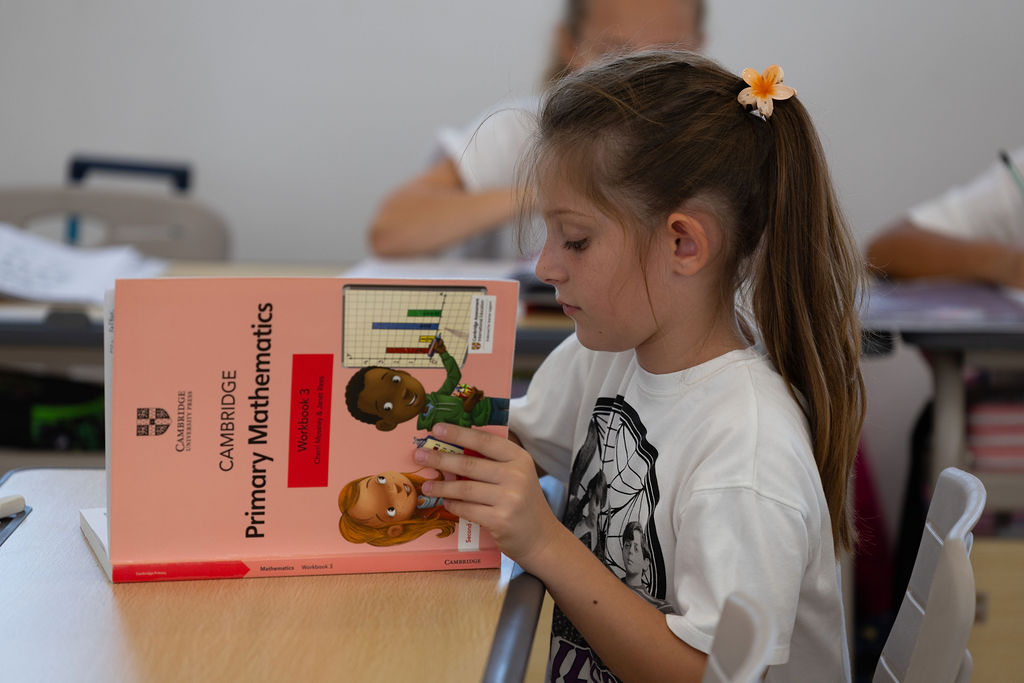
During a school visit, ask to see an appropriate example of a maths task and how the teacher would discuss a pupil’s method. A workbook can show the question; the explanation helps you understand the learning.
Cambridge Primary maths: parent questions
Is reasoning separate from normal maths lessons?
In Cambridge’s framework, Thinking and Working Mathematically runs through the subject. It connects with the mathematical content being learned. Ask the school how that looks for the class you are considering.
Should I teach a faster method at home?
Check the class approach first. Ask the teacher to demonstrate the method and explain its purpose before introducing a different shortcut. You can then help your child connect the steps with the underlying idea.
Are these examples suitable for every Primary child?
They illustrate different kinds of thinking, not fixed expectations for every age. Use the teacher’s guidance to choose numbers, language and representations that fit your child’s current learning.
See the Primary programme for yourself
Arrange a Golden Oak school tour to visit the classrooms and discuss Cambridge Primary learning, the appropriate class and the next step for your child.