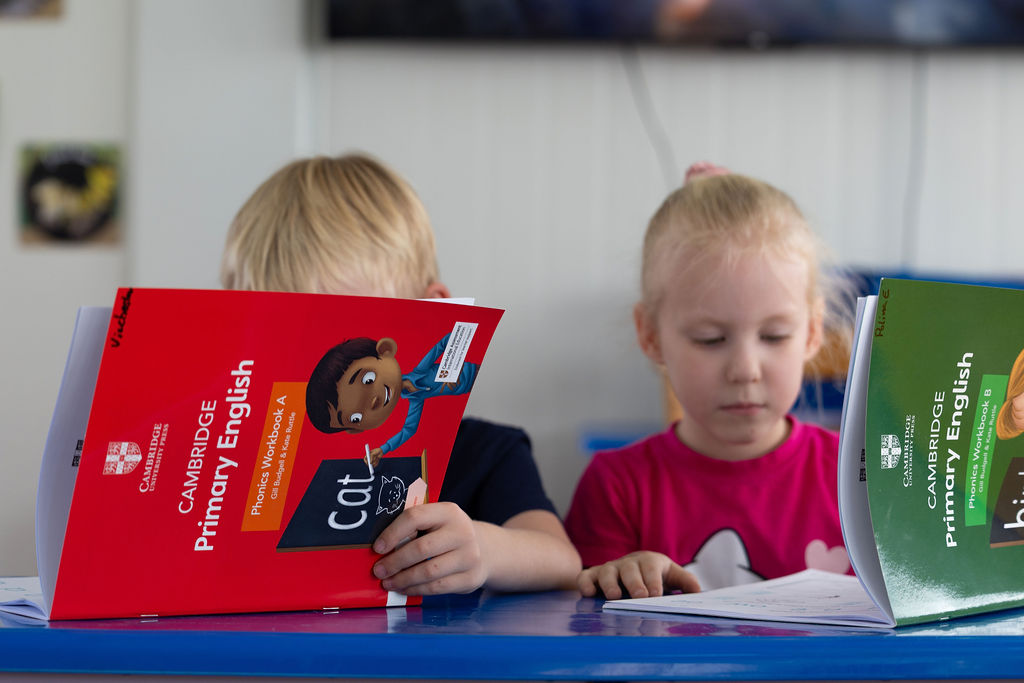
Phonics helps children connect the sounds in spoken English with the letters that represent them, then combine those sounds to read words. For parents in Cyprus, the most useful home support starts with the school’s current teaching: find out which sounds your child knows, how the teacher pronounces them and which reading material is suitable for practice.
Learning to read also involves understanding words and enjoying stories. A child who can sound out a word may still need help with its meaning, particularly when English is an additional language. This guide explains the terminology and offers practical questions for families approaching Reception or early Primary.
What do phonics, blending and segmenting mean?
Three terms often appear in early reading conversations. A phoneme is a speech sound. A grapheme is a letter or group of letters representing a sound. Blending means joining sounds to read a word; segmenting means separating a spoken word into sounds for spelling. These distinctions are explained in the Department for Education’s Reading Framework, which is guidance for England rather than a statement of requirements for schools in Cyprus.
| Term | A simple example |
|---|---|
| One letter representing a sound | The letter m represents the first sound in map. |
| Two letters representing one sound | In shop, sh represents one sound. |
| Blending for reading | Join the sounds represented by m, a and p to read map. |
| Segmenting for spelling | Say map, identify its three sounds and choose the letters to write. |
Use examples your child’s teacher has already introduced. Letter names and letter sounds serve different purposes, so ask for a demonstration if you are unsure which to use during a particular activity.
Start with the teacher’s current focus
A useful first question is: “What would you like us to practise this week?” Bring the reading book or sound sheet to the conversation. Ask the teacher to show you one example and explain what to do if your child gets stuck.
Make a small home note with three entries: the current sounds, the agreed reading material and the help you can offer. This gives other adults who read with your child a consistent starting point. It also avoids buying a set of resources before knowing whether they fit the classroom sequence.
For Golden Oak families, ask the class teacher which phonics resources are being used in your child’s class. The school’s Cambridge curriculum information gives the wider context; it does not replace that class-specific conversation.
Try a short reading routine you can repeat
Choose a comfortable moment and put the agreed book somewhere easy to find. The following is an example routine to adapt with the teacher, not a required session length or a promise about reading speed.
- Begin with something familiar. Invite your child to show you a sound or word they have been practising.
- Read a manageable part. Follow the approach demonstrated by the teacher and allow your child time to respond.
- Notice one useful action. For example: “You went back to the letters when you were unsure.”
- Talk about meaning. Ask a simple question about the sentence or connect a new word to something familiar.
- Finish with a story together. Your read-aloud book can be different from the book used for independent practice.
If a word causes repeated difficulty, write down the word and what happened. “Recognised the first sound but could not join the sounds” gives the teacher a more precise starting point than “reading was difficult”.
Keep understanding alongside word reading
A useful distinction is between reading practice and a shared story. During practice, your child works with material chosen for their current skills. During a read-aloud, you can handle the text and enjoy the characters, ideas and unfamiliar vocabulary together.
Cambridge Primary English brings reading, writing, speaking and listening together. That broader view helps when discussing progress: ask about understanding and communication as well as the words your child can read aloud.
For example, after reading about a shop, you might talk about what you buy at your local shop in Limassol. Keep the conversation natural. The goal of this example is to connect a word with meaning, not to turn every outing into a phonics lesson.
What if your family uses another language at home?
Tell the teacher which languages your child hears, speaks and reads, including any literacy teaching received elsewhere. Ask for an English sound demonstration or an approved pronunciation resource if that would help the adults at home.
When discussing a difficulty, describe the task precisely. Was the unfamiliar part the English word, the letter pattern, the instruction or the story’s meaning? Those questions help you seek useful guidance without drawing conclusions about your child from one exercise.
Questions parents often ask
Does a Cambridge school automatically use one phonics scheme?
No. Cambridge offers a Phonics and Handwriting scheme, but the availability of that resource does not establish that a particular school or class uses it. Ask Golden Oak’s teacher to identify the current materials and teaching sequence.
Should my child read independently before starting school?
Check the expectations for the particular class with admissions and the teacher. Do not treat this home guide as an entry requirement. Reading together and discussing the intended starting point are useful ways to prepare.
Discuss early reading at Golden Oak
Explore the Primary School programme in Limassol or arrange a visit to discuss early literacy. Bring a question about how reading is taught, how progress is shared and how families can support the classroom approach at home.