Cambridge Primary and the IB Primary Years Programme are international approaches to education with different ways of organising learning. Cambridge provides subject curriculum frameworks that schools can combine and adapt. The IB PYP connects learning across subjects through inquiry. To compare schools in Cyprus, examine both the programme and how the individual school teaches it.
Neither name, by itself, describes your child’s entire school day. The timetable, teaching language, classroom practice, support and communication with parents all need their own questions. This guide focuses on the primary years, rather than the later IGCSE, A Level or IB Diploma qualifications.
What is Cambridge Primary?
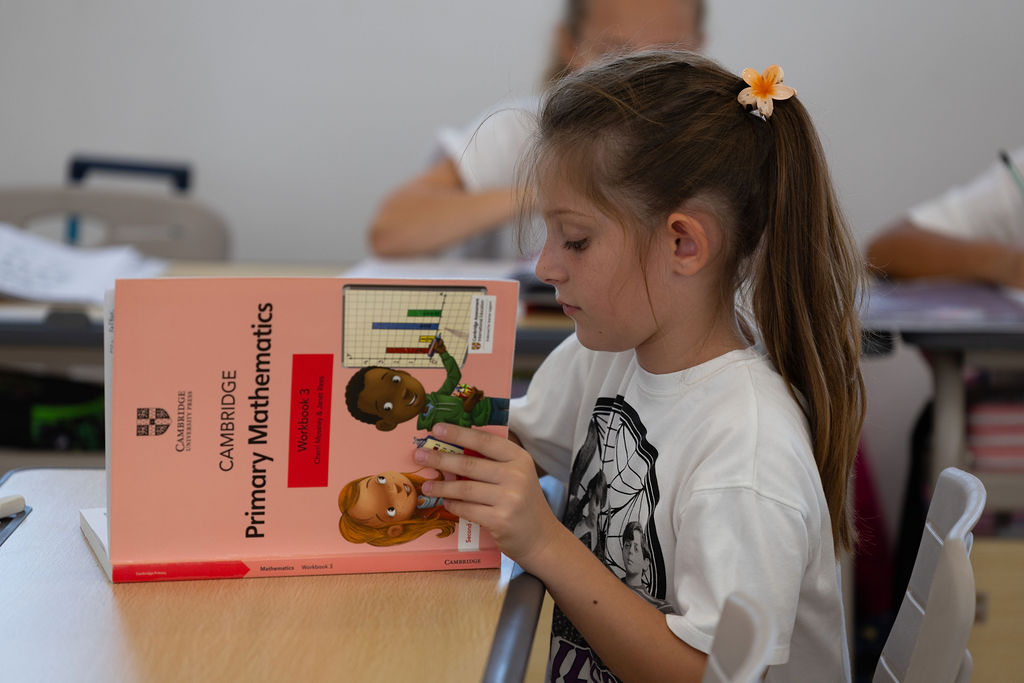
Cambridge Primary is typically designed for children aged 5–11. Its curriculum includes a choice of more than ten subjects, with English, mathematics and science among the available frameworks. Schools choose their combination and can adapt delivery to their context.
That flexibility makes the school’s own explanation valuable. Ask which subjects it offers, how teachers sequence learning and how they identify the next step for an individual pupil. The full Cambridge catalogue should not be read as a promise that every Cambridge school teaches every available subject.
The programme’s typical age range is also distinct from a school’s admission and class-placement arrangements. Confirm the appropriate year group directly, particularly when moving between countries or school systems.
What is the IB Primary Years Programme?
The International Baccalaureate Primary Years Programme, usually called the PYP, is intended for children aged 3–12. It is a framework centred on inquiry, concepts and learning across subject boundaries. The IB uses the term “transdisciplinary” to describe those connections.
For parents, a useful question is how a school connects an inquiry with the knowledge and skills children are developing. Ask for an example from the relevant class: what did children investigate, what did the teacher teach explicitly, and what did their work show?
The IB describes an authorisation process for schools implementing the PYP. When considering an IB option, check the school’s status and the specific programme it offers. A reference to IB education at another age does not establish PYP provision for a younger child.
Compare structure without oversimplifying teaching
| Question | Cambridge Primary | IB PYP |
|---|---|---|
| How is learning organised? | Through subject frameworks selected and implemented by the school. | Through an inquiry framework that connects learning across subjects. |
| What should parents ask to see? | A subject plan, classroom work and the next learning objectives. | An inquiry example, classroom work and the knowledge and skills developed. |
| What still depends on the school? | Delivery, timetable, support and communication. | Delivery, timetable, support and communication. |
Treat the table as a starting point for a conversation. It does not justify describing Cambridge as only memorisation or the PYP as only free exploration. Ask teachers to explain their decisions using actual work from the class rather than relying on a broad label.
For example, you could ask both schools how pupils learn to explain their mathematical reasoning. Then ask how a teacher recognises a misunderstanding and responds. These questions let you compare an observable process without assuming the answer from the curriculum name.
How is progress assessed?
Cambridge offers classroom assessment guidance, Progression Tests and Primary Checkpoint. Schools can use combinations of its assessment options. Ask which tools the particular school uses, at which stages and how the results shape teaching. An option at programme level does not mean a pupil can disregard the school’s own assessment requirements.
The IB’s PYP description includes ongoing assessment and feedback as part of learning. Ask a PYP school how it records progress, communicates it to families and identifies gaps in understanding. In both settings, a useful explanation connects evidence of learning with what happens next.
Questions to take to either school
- Can you show me a recent piece of work and explain what the child was learning?
- How do reading, writing and mathematics develop through this year group?
- How would you support a child joining from a different curriculum?
- How do you respond when a child needs more practice or greater challenge?
- How will we understand our child’s progress during the year?
Write down the answers alongside your child’s interests, previous experience and practical needs. Keep wider school factors in view, including the journey, daily hours and the relationship you can build with the team.
Where Golden Oak fits
Golden Oak describes its Primary School provision as Cambridge education in English. Read the Cambridge Primary parent guide for more detail about the programme, or book a school tour to discuss how it works in the classroom.
Programme information checked against Cambridge International Education and International Baccalaureate sources on 12 October 2026.