English, mathematics and science form the core of Golden Oak’s Cambridge Primary learning in Limassol. Reading and communication, mathematical reasoning and scientific investigation develop alongside a wider school curriculum that includes languages, creative subjects, physical education and personal development.
For a parent choosing a Primary school, a subject list is only the beginning. The more useful picture is what children are learning to do within each subject and how the school explains their next steps. Here is an introduction to the programme at Golden Oak in Agios Athanasios.
English: reading, writing, speaking and listening
Golden Oak’s Cambridge curriculum overview describes English as the development of reading, writing, speaking and listening together. Children work towards understanding different texts, expressing ideas and communicating with growing confidence.
This is broader than learning to recognise words. When discussing the programme, it is useful to look at the connection between understanding a text, talking about it and writing a response. Ask to see an example appropriate to the year group you are considering, rather than comparing an older pupil’s finished work with the starting point of a younger child.
For families approaching the early stages of reading, our phonics and early-reading guide explains the terminology used in conversations about sounds, blending and books. Discuss the class teacher’s approach before adding extra work at home so that home support and classroom learning fit together.
Mathematics: understanding the reasoning
The mathematics programme describes number, shape, measure and patterns as tools for solving problems. Golden Oak emphasises explaining mathematical thinking and connecting ideas with everyday life, alongside building confidence with calculations.
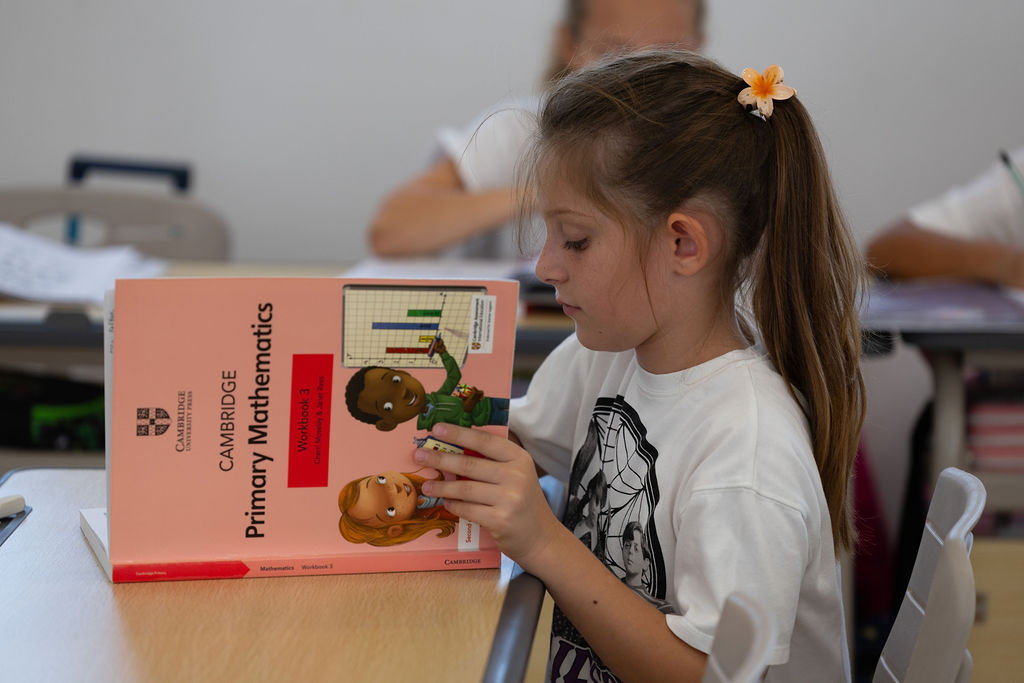
The article’s photograph shows a Golden Oak pupil with a Cambridge Primary Mathematics workbook. It is one example of a resource present in the classroom. The curriculum is not defined by a workbook alone: a useful conversation with the school connects the resource to what pupils are learning and the reasoning behind their answers.
For example, a parent could ask a teacher to explain how a child approaches a problem when the first method does not work. Does the next step involve discussing the question, representing it differently or revisiting an earlier idea? These are examples of questions for understanding teaching, not a fixed account of how every Golden Oak mathematics lesson is delivered.
Science: questions, observations and investigation
Golden Oak describes science through questions, observations and hands-on investigations of the living and physical world. The aim within the programme is to develop scientific thinking alongside subject knowledge.
During a visit, ask for an example of a recent investigation from the relevant class. What question were pupils considering? What did they observe? How did they record or explain what they found? A specific classroom example helps parents understand the difference between seeing an interesting activity and understanding its learning purpose.
Science also provides a useful point of connection with English and mathematics. A teacher can show how pupils describe observations clearly or use measurements in an investigation. The precise tasks and expectations should be discussed for your child’s stage rather than assumed from the name of the subject.
A broader Primary education
The Golden Oak Primary School programme extends beyond those three core areas. The published subject information includes geography, history and Greek, as well as music, art, drama, physical education, mindfulness and personal development.
This matters when a family is comparing schools on more than academic labels. The school day also needs to make sense for a child who enjoys making, moving, performing or working with others. Ask how the wider subjects are organised in the intended class, and distinguish the normal curriculum from optional specialist clubs.
Following progress rather than only collecting marks
Golden Oak’s Cambridge page states that formal assessments and reports are provided twice a year. It also describes teachers adapting classroom work to children’s strengths and areas needing more practice. Our Cambridge Primary assessment guide separates the wider programme’s assessment options from the school’s own expectations.
When discussing a report, connect it with one concrete next step. For English, this might be the part of reading or writing to practise; for mathematics, the idea behind a recurring difficulty; for science, how clearly the child explains an observation. The teacher can identify the appropriate priority rather than parents having to infer it from a score alone.
For home support, the Primary homework guide offers a starting point for discussing a manageable routine. The class teacher’s instructions should guide the actual work and expectations for your child.
Joining from another school or language background
Bring information about your child’s previous schooling, current class and language experience to the admissions conversation. That helps make the discussion about English-medium Cambridge learning specific to the child, rather than assuming that a familiar year-group name means an identical programme.
Golden Oak’s Primary overview describes Years 1–6. Confirm the class and availability for your intended intake directly with admissions. The published 2026/27 standard Primary day is 07:30–15:30, September to June; optional services and their costs should be confirmed separately.
Cambridge Primary subjects: frequently asked questions
Which core subjects does Golden Oak teach?
Golden Oak’s Cambridge Primary information highlights English, mathematics and science, alongside a wider curriculum of languages, humanities, creative subjects and physical education.
Is Primary education taught in English?
Golden Oak describes its Primary programme as English-medium. Discuss your child’s language background and the relevant entry expectations with admissions.
Can parents see examples of classroom work?
A school tour is an opportunity to request examples from the intended year group and ask the team to explain the learning objectives, feedback and next steps.
Explore Primary learning at Golden Oak
Arrange a school tour in Limassol to see the environment and discuss your child’s learning. For placement questions, contact Golden Oak admissions with the current school stage and intended start date.
School-specific information is based on Golden Oak’s current Cambridge and Primary programme pages and the 2026/27 financial schedule. Ask the school for examples and expectations specific to your child’s intended class.